
At Auptician on Hairst Street, Renfrew, we’ve invested in technology you’d normally only find in hospital eye departments or specialist clinics in the city.
Below are five things we do differently:
1. A Biometric Eye Test: That measures your eye, not an average one
A standard eye test works out your prescription from a handful of values. It answers the question “which lens makes the letters clearest?” It doesn’t map the eye itself.
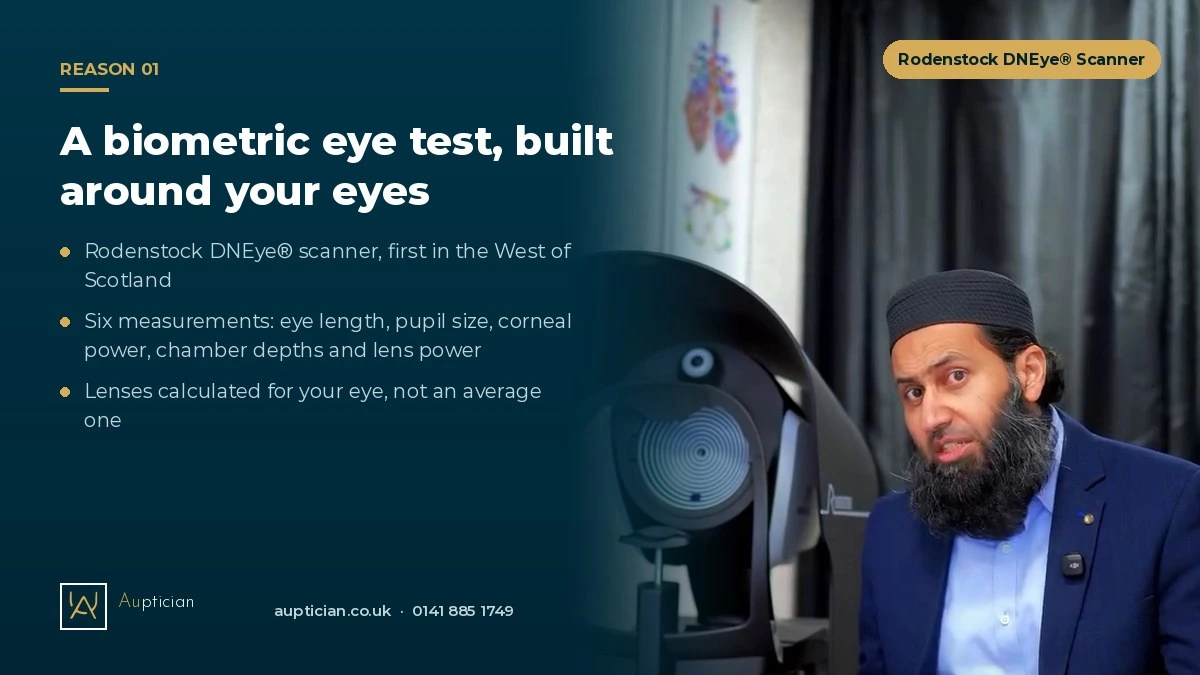
We were the first practice in the West of Scotland to offer the Rodenstock DNEye® Scanner. It takes thousands of measurement points from each eye. From these, we look closely at six things:
- Eye length: how long the eye is from front to back
- Pupil size: in daylight and in low light
- Corneal power and thickness: the shape and strength of the clear front window of the eye
- Anterior chamber depth: the space between the cornea and the lens
- Crystalline lens power: the focusing strength of your natural lens
- Vitreous chamber depth: the depth of the gel-filled space at the back of the eye
Why it matters?
No two eyes are built the same, even when two people have the same prescription on paper. When lenses are calculated from your eye’s real measurements, the sharpest zone of the lens lines up with how you actually see. Patients often notice the difference most at night, when driving or reading in dim light.
The data feeds straight into Rodenstock biometric lenses, made to your individual measurements. It’s also helpful for children: tracking eye length over time is one of the best ways to monitor short-sightedness (see our myopia management service).
2. OCT Scans: That can spot eye disease years before you notice it
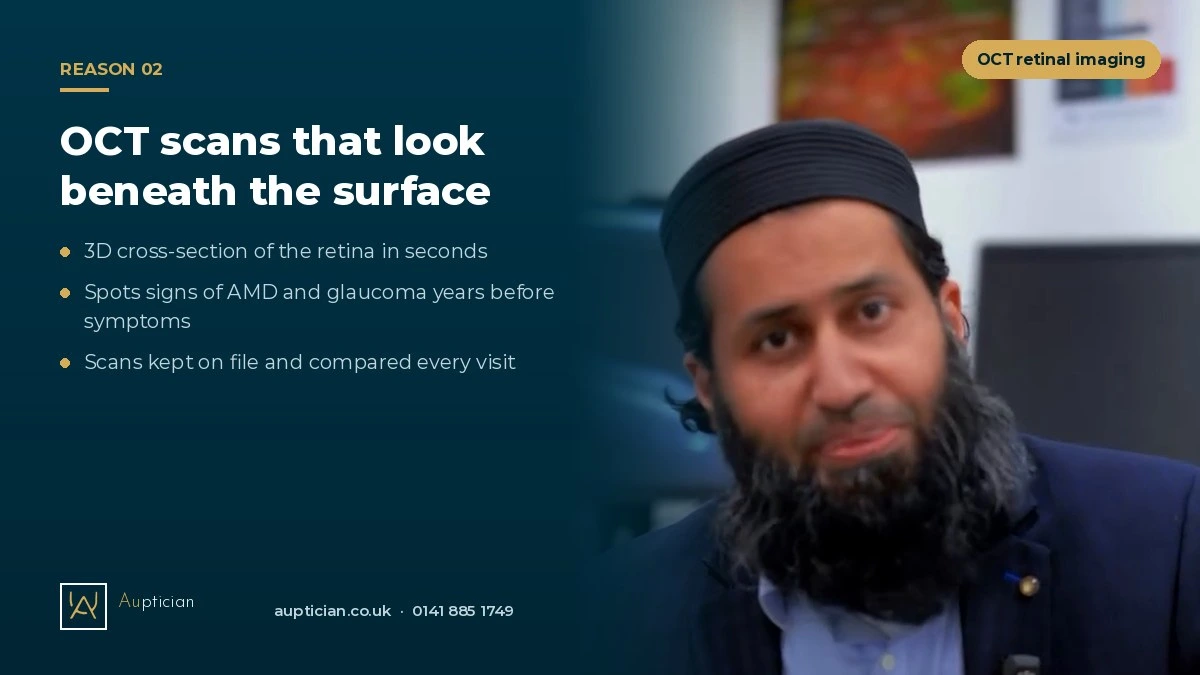
An ordinary photo of the back of the eye shows the surface. An OCT (optical coherence tomography) scan shows the layers underneath, like a cross-section. It works a bit like ultrasound but uses light instead of sound. It takes a few seconds, and nothing touches your eye.
That cross-section matters because many serious eye conditions start below the surface. The Macular Society notes that OCT can pick up early changes in the retina before you notice any symptoms. We use it to look for:
- Age-related macular degeneration (AMD): the most common cause of central sight loss in the UK, usually starting after age 50 (NHS)
- Glaucoma: by measuring the nerve fibre layer around the optic nerve. See our glaucoma screening.
- Diabetic eye changes, macular holes and fluid under the retina
What this means for you?
Catching a problem early often means more treatment options and a better chance of keeping your sight. Because we keep your scans on file, we can compare them year on year and spot small changes a one-off test would miss. Find out more on our macular screening page.
3. Valeda Light Therapy for Dry Macular Degeneration: One of only two in Scotland
For years, people diagnosed with dry AMD were told the same thing: there’s no treatment, take your supplements and come back in a year. That’s a hard message to hear.
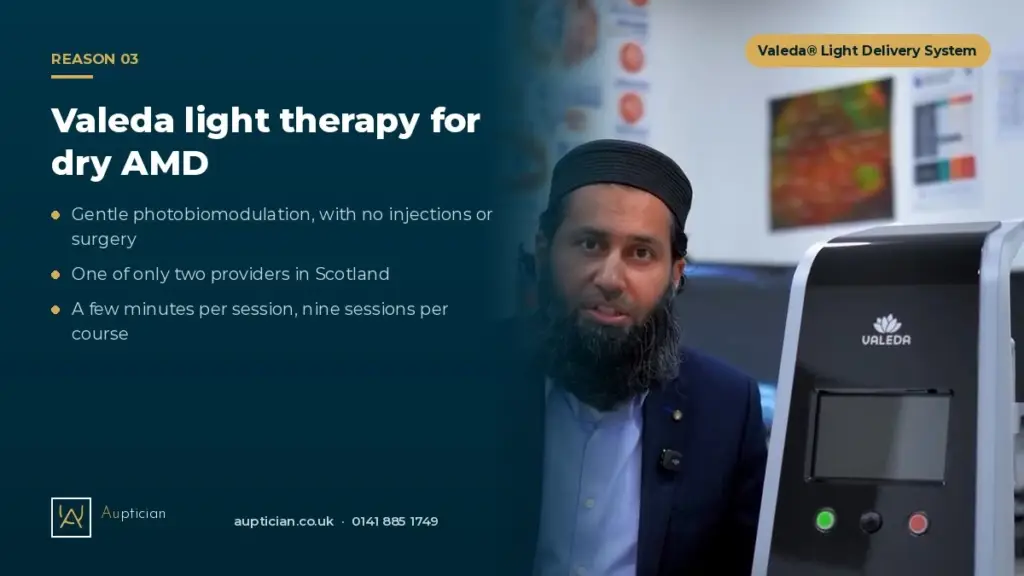
Valeda® (by LumiThera) offers another option. It uses gentle, low-level light at specific wavelengths, known as photobiomodulation, to support the stressed cells in the macula. There are no injections, no surgery and no anaesthetic. You sit at the machine, look into it with your eyes open and the session takes a few minutes.
What the research shows?
In the LIGHTSITE III clinical trial, patients with mostly intermediate dry AMD gained an average of around five letters on the eye chart. They were also less likely to progress to geographic atrophy, the advanced stage of dry AMD (Healio, 2023). The usual course is nine sessions over three to five weeks, repeated about every four months.
Auptician is one of only two places in Scotland to offer this treatment. That means patients from Glasgow, Paisley, Inverclyde and beyond no longer need to travel far, or abroad, to get it.
Valeda isn’t right for everyone, and it isn’t used for wet AMD. We’ll scan your eyes first and tell you honestly whether you’re a good candidate. Read more about Valeda light therapy at Auptician.
4. Glasses fitted to your face with the "magic mirror"
An accurate prescription is only half the job. If the lenses don’t sit correctly in front of your pupils, even a perfect prescription can feel slightly off, especially with varifocals.
That’s why fitting is our last step. Once you’ve chosen a frame, you stand in front of our digital centration mirror, which we call the magic mirror. It measures exactly where your eyes sit within that frame: pupil distance, fitting height, frame tilt and how far the lens sits from your eye. Those measurements go to the lab with your biometric results from the scanner (Reason 1).
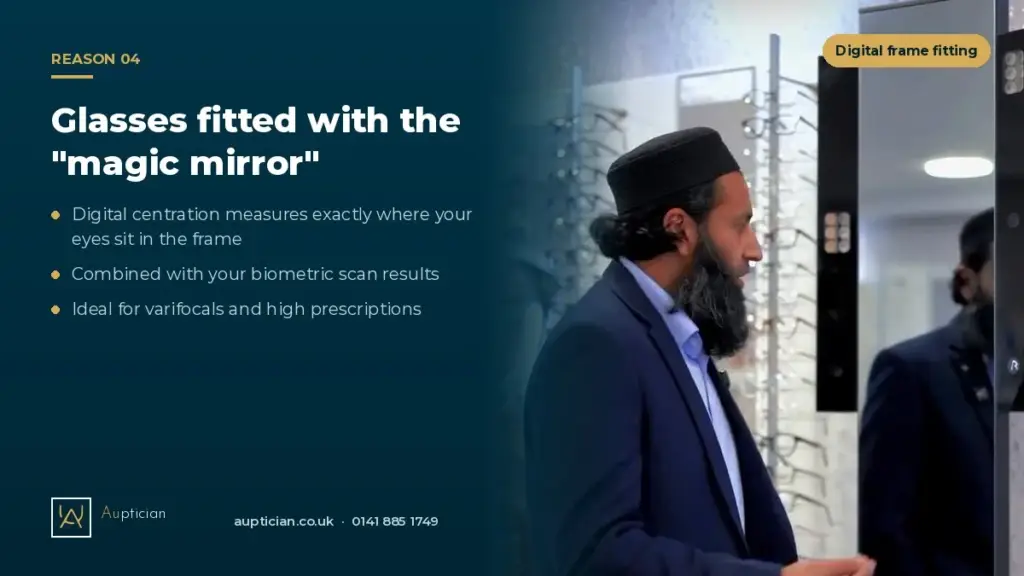
The result is a pair of glasses made for your eyes, your face and that frame, rather than adjusted from a standard template. It’s especially useful for:
- Varifocal wearers: a few millimetres can decide whether the reading zone is comfortable or a struggle
- High prescriptions: where small fitting errors cause headaches or distortion
- Anyone who’s had “new glasses that never felt right”
You can browse frames from brands like Ray-Ban, Hugo Boss, Ted Baker and Nike Vision in our online shop before you visit.
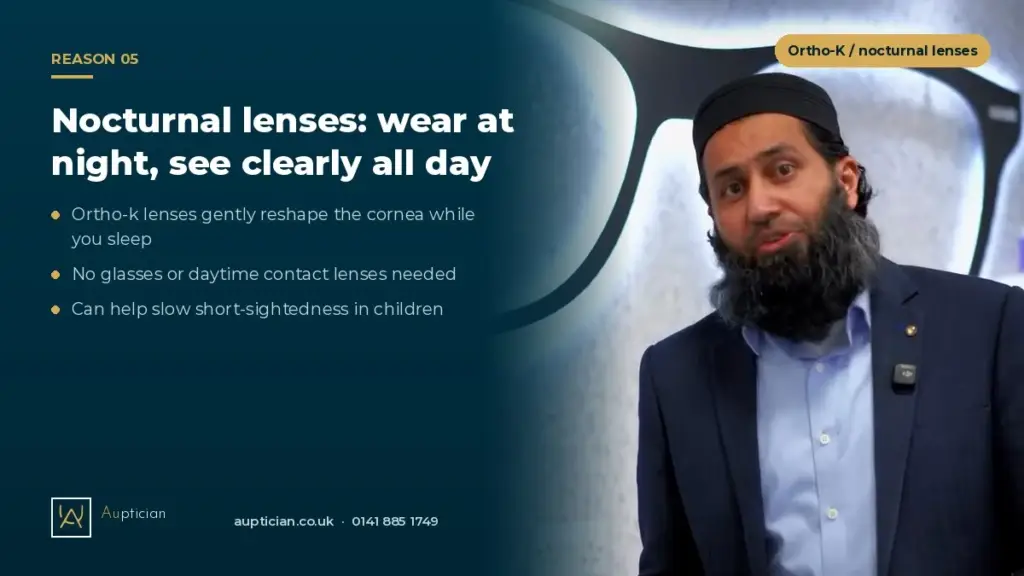
5. Nocturnal lenses: Clear vision all day without glasses or daytime contacts
Some people want to stop wearing glasses but aren’t ready for laser surgery, or can’t wear daytime contact lenses comfortably. Footballers, swimmers, people working in dusty places and children who keep losing their glasses all fall into this group.
Nocturnal lenses, also called ortho-k (orthokeratology), are a third option. You put in specially designed rigid lenses at bedtime. While you sleep, they gently reshape the front surface of the cornea. In the morning you take them out and see clearly all day, with nothing in your eyes and nothing on your face. The effect is temporary and reversible: stop
Why parents ask about them?
For children who are becoming more short-sighted, ortho-k is one of the established ways to help slow that progression. That’s why we often fit it alongside myopia management, using the eye-length readings from our biometric scanner to track progress.
Safety comes first
Any lens worn overnight carries a small risk of infection, so careful fitting and good hygiene really matter. The College of Optometrists advises an overnight trial fit, clear hygiene training and regular aftercare. That’s exactly how we work. Find out more on our nocturnal lenses page or see all our contact lens options.
Frequently Asked Questions
Yes. Your NHS eye examination in Scotland is free and checks your eye health and prescription. The biometric scan adds detailed measurements of your eye’s structure, which we use for Rodenstock individual lenses and for monitoring children’s myopia. Ask us at booking which options suit you.
No. You rest your chin, look at a target, and the scan takes a few seconds. Nothing touches your eye.
No. Valeda is for dry AMD. Wet AMD needs urgent hospital treatment, usually injections. If you notice sudden distortion or a dark patch in your central vision, contact us or your GP the same day.
We fit children once they can handle lenses safely with a parent’s help, often from around age 8. We’ll assess each child individually.
No. You can book directly with us.
Come and see us at Auptician, 55 Hairst Street, Renfrew PA4 8QU. We’re open Monday to Saturday.
- Call 0141 885 1749
- Email team@auptician.co.uk
- Book an appointment online
About Author
Ahmed Qazi, BSc (Hons) Optom, MCOptom, Dip IP, Prof Cert Glaucoma, PGDip Ocular Therapeutics, MSc Investigative Ophthalmology and Vision Research (Glasgow Caledonian University)
Ahmed is Director and Lead Optometrist at Auptician. He has worked in eye care since 2004, starting as an optical assistant and training through hospital work at Coventry. Since then he has practised with leading UK opticians and spent five years working overseas. He has also taught future optometrists as a Clinical Supervisor at the University of Bradford. He is an independent prescriber (Dip IP), which means he can prescribe medicines for eye conditions. His particular interests are retinal imaging, glaucoma, myopia control and new treatments for macular degeneration, including the Valeda light therapy described above.